
The fire suppression system is designed to detect, alert, and respond to potential fire hazards within the AES Cabinet and communicate critical events to the AES BCU and LYNK II Gateway. The system operates based on the detection of fumes or abnormal thermal conditions, triggering appropriate response mechanisms.
Safety Actions
|
Device |
Purpose / Action |
|---|---|
|
Audible and visual alarms |
Alert personnel for immediate response. |
|
Emergency stop |
Allows manual shutdown in case of unsafe conditions. |
|
Pack-level Aerosol Fire Extinguishing Devices |
Provide localized pack-level suppression, independently triggered by internal temperature sensors within the battery pack. |
|
Cabinet-level Aerosol Fire Extinguishing Devices |
Activated by a thermal heat sensor within the cabinet. |
|
Deflagration vents |
Safely relieve pressure to mitigate the risk of catastrophic high-pressure failure. |
|
Battery Pack Aerogel-based thermal separators |
Prevent thermal runaway propagation by providing high-temperature insulation between cells. |
|
Communication with AES BCU and LYNK II |
Ensures data logging, real-time monitoring, and further decision-making regarding system events. |
Fire Detection Response
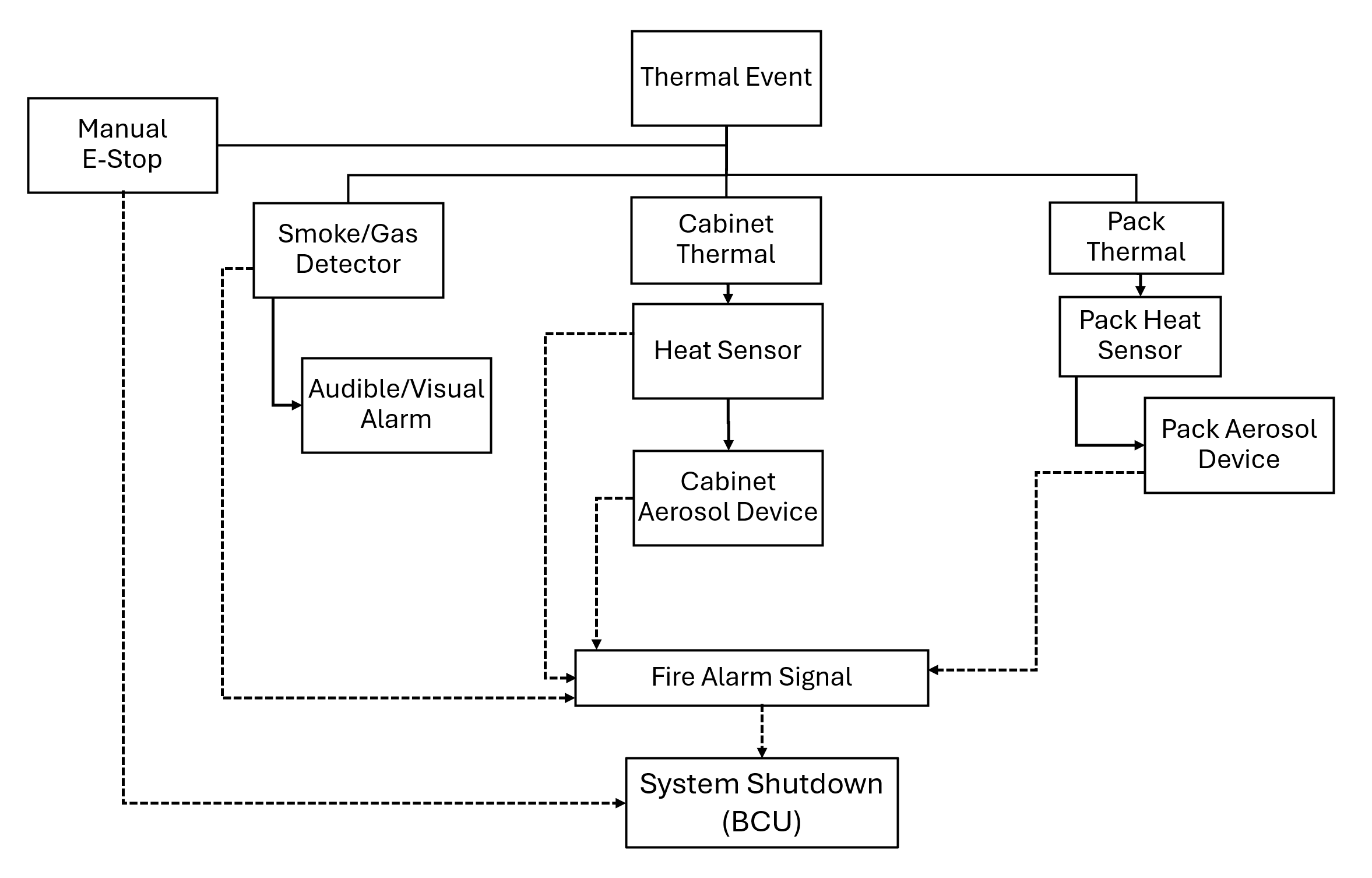
E-Stop (Emergency Stop Switch)
The Emergency Stop (E-Stop) is a hardwired, manual shutdown mechanism that provides immediate isolation of the AES Cabinet battery system in the event of an emergency or unsafe operating condition.
-
The E-Stop is mounted on the exterior of the cabinet for easy access by operators or emergency responders.
-
When pressed, the E-Stop cuts off power to the Battery Control Unit (BCU) and opens all contactors, including those within the battery packs and high-voltage box.
-
This action results in a complete shutdown of all charging, discharging, and thermal management operations.
-
The system remains in a latched-off state until the E-Stop is manually reset and commissioning procedures are followed.
The E-Stop function is independent of software or inverter control and is considered a critical first-response tool in situations involving smoke, overheating, fire risk, or system malfunction. It also satisfies safety compliance requirements in accordance with industrial battery system standards.
Fumes Detection (Smoke Sensor)
The AES Cabinet is equipped with an integrated smoke detection sensor that continuously monitors the internal airspace for signs of combustion byproducts, smoke, or other airborne contaminants.
-
If the sensor detects the presence of fumes beyond a calibrated threshold, the system triggers a pre-alarm condition to alert operators.
-
This includes activation of:
-
A visual alarm beacon (typically flashing red LED)
-
An audible alarm (high-decibel tone or buzzer) mounted on the cabinet
-
-
Concurrently, a digital fire alarm signal is sent to the BCU, prompting an immediate system-level shutdown.
This function provides critical early-stage fire risk detection, allowing intervention before temperatures rise to trigger the thermal suppression system. The smoke sensor acts as an active layer of defense in combination with passive suppression systems such as aerosol devices and thermal separation materials.
|
NOTE |
|---|
|
While the smoke detection system can trigger alarms and shutdown, it does not activate the aerosol fire suppression system, which operates independently through thermal triggers. |
Thermal Runaway (Excessive Heat Detection)
The AES 210HV battery system features a multi-tiered, passively activated fire suppression architecture designed to detect and respond to thermal runaway or high-heat events at both the battery pack and cabinet levels. These systems operate independently of software control or AC power input, offering robust, redundant protection.
Pack-Level Aerosol Fire Extinguishing Devices
Each battery pack is equipped with a self-contained aerosol fire suppression unit. These devices are directly triggered by dedicated internal temperature sensors embedded within the battery module.
-
Activation occurs automatically when internal pack temperatures exceed a predefined thermal threshold.
-
The unit releases an aerosol compound that quickly suppresses combustion and interrupts thermal propagation.
-
No external control system or communication link is required to activate the device.
-
Upon activation, a signal is sent to the Battery Control Unit (BCU) to initiate a safe system-wide shutdown.
This localized suppression ensures a fast and targeted response to any pack-level thermal anomaly, minimizing the risk of spread and allowing the system to isolate the event.
Cabinet-Level Aerosol Fire Extinguishing Device
The battery cabinet also includes a cabinet-level FS0050 aerosol fire suppression system, designed to protect against broader thermal events affecting the cabinet as a whole.
-
A dedicated thermal sensor located within the cabinet continuously monitors for abnormal temperature increases.
-
If excessive heat is detected, the FS0050 canister is automatically triggered to release its suppressant throughout the enclosure.
-
Like the pack-level units, this system functions independently and does not rely on the BMS, control logic, or AC power.
-
An activation signal is sent to the BCU, which commands a full system shutdown for safety.
Together, these passively activated systems form a redundant, fail-safe fire suppression network, capable of functioning even during partial system faults or loss of communication. Their autonomous design ensures that thermal events are addressed rapidly and effectively, regardless of the system’s operational state.
Control and Communication
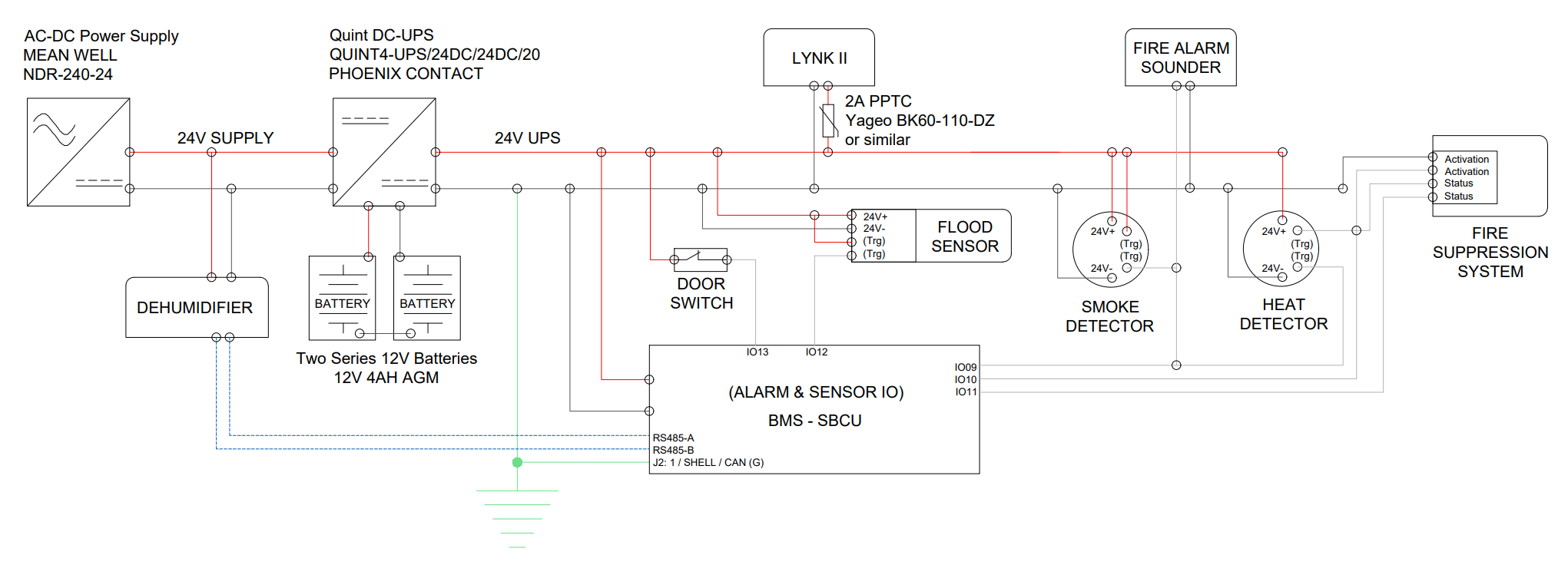
The Battery Control Unit (BCU) serves as the central processing and safety coordination hub within the AES Cabinet. It interfaces with all critical safety and environmental monitoring devices, including fire detection sensors, the emergency stop circuit, and the LYNK II communications gateway.
System Power Architecture
-
The control system is powered by a 24V DC supply derived from a MEAN WELL AC-DC power supply.
-
A Phoenix Contact QUINT DC-UPS with two 12V AGM batteries provides backup power to ensure all control systems remain operational during loss of AC supply.
-
This backup system maintains functionality of fire detection, system shutdown logic, and critical communication paths.
BCU Safety Signal Integration
The BCU continuously receives input from environmental and safety sensors:
-
Smoke Detector: Detects airborne particulates or fumes and signals the BCU if thresholds are exceeded.
-
Heat Detector: Monitors for abnormal increases in cabinet temperature and alerts the BCU to initiate protective actions.
-
Flood Sensor: Provides detection of water ingress at the base of the cabinet, signaling a potential safety hazard.
-
Door Switch: Detects unauthorized or unintentional access to the cabinet and logs or triggers alarms if required.
-
Emergency Stop (E-Stop): When pressed, immediately disables the BCU and triggers a system-wide shutdown.
Response Mechanisms
When a fault or safety condition is detected:
-
The BCU issues a shutdown command.
-
It also triggers the fire alarm sounder, which provides both audible and visual alarms for site personnel.
-
Simultaneously, the BCU sends diagnostic or fault status updates to the LYNK II gateway, which logs and forwards data to external monitoring platforms.
Communication & Monitoring
-
The BCU communicates CAN protocols to interface with the broader battery management system.
-
It provides real-time status to the LYNK II, enabling remote diagnostics, event logging, and alarm forwarding to external supervisory control systems.