|
|
|---|
|
ELECTRIC SHOCK AND FIRE HAZARD
Failure to follow these instructions may result in death or serious injury. |
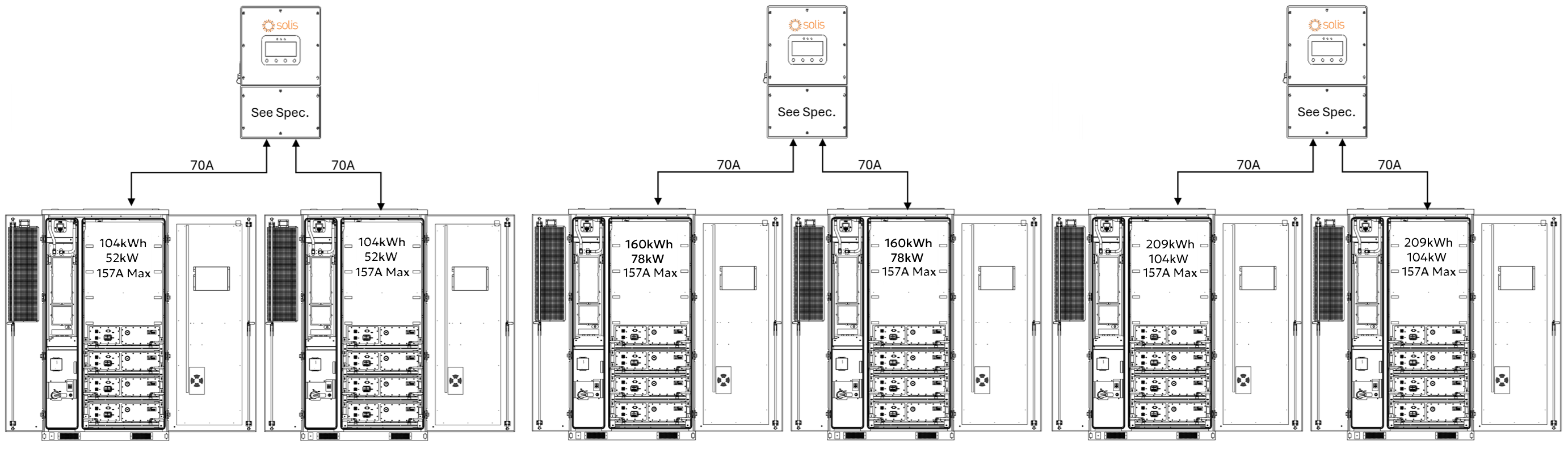
CAB-106, CAB-160, and CAB-210 Configurations
When two AES Cabinets are paired with a single Solis inverter, the AES Cabinet’s maximum continuous current limit is 157 A, operating within its rated 209 / 314 / 418 kWh continuous output limit. Actual discharge performance depends on the inverter model’s battery-side power capacity, as shown below.
Full Load Duration
|
Inverter
|
Battery Discharge Limit |
CAB-106 |
CAB-160 |
CAB-210 |
|---|---|---|---|---|
|
AC Output / Usable Storage / Estimated Runtime |
||||
|
S6-EH3P29.9K03-H-AU |
29.9 kW |
29.9 kW / 208 kWh / 7 hours |
29.9 kW / 314 kWh / 10½ hours |
29.9 kW / 418 kWh / 13½ hours |
|
S6-EH3P30K03-H-AU |
30 kW |
30 kW / 208 kWh / 7 hours |
30 kW / 314 kWh / 10½ hours |
30 kW / 418 kWh / 13½ hours |
|
S6-EH3P40K03-H-AU |
40 kW |
40 kW / 208 kWh / 5 hours |
40 kW / 314 kWh / 7½ hours |
40 kW / 418 kWh / 10½ hours |
|
S6-EH3P50K03-H-AU |
50 kW |
50 kW / 208 kWh / 4 hours |
50 kW / 314 kWh / 6 hours |
50 kW / 418 kWh / 8 hours |
* Curtailed by the battery.
These autonomy estimates assume continuous full-power discharge and operation within safe continuous discharge parameters. Final performance should match the site's energy demand and load profile.
System Scalability – One Inverter, Two AES Cabinets
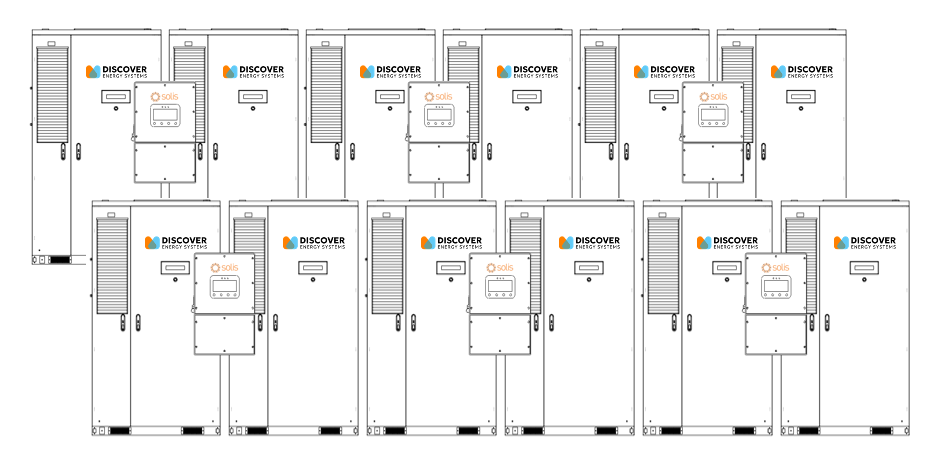
Each Solis inverter can be paired with two AES battery cabinets, doubling the usable energy per inverter while maintaining discharge power based on inverter size.
In this setup:
-
209 / 314 / 418 kWh of usable backup energy per inverter (2 × 10⁴ kWh / 2 × 157 kWh / 2 × 209 kWh)
-
Discharge power limited by the inverter model (29.9–50 kW)
-
Up to ten inverters can be connected in parallel on the backup side, supporting 299-500 kW of backup power and approximately 2.09–4.18 MWh of total backup energy (10 × 209 kWh / 10 × 314 kWh / 10 × 418 kWh).
Grid-Tied (Non-Backup) Scalability
The number of inverters or batteries is unlimited for non-backup use. Each inverter runs independently, allowing systems to scale as large as needed for energy shifting, peak shaving, or other grid-interactive applications.
DC Battery Wiring – One Inverter, Two AES Cabinets
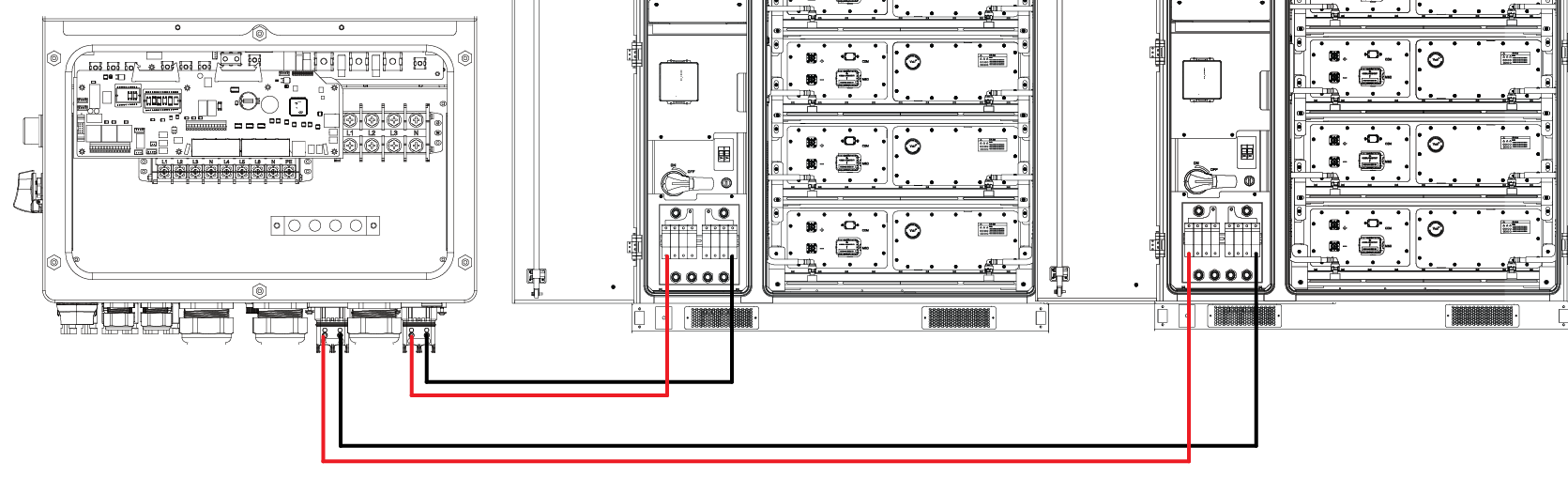
When connecting two AES battery cabinets to a single Solis inverter, each cabinet is wired to a dedicated battery input terminal on the Solis inverter:
-
Battery 1 connects to the inverter’s BAT1 terminals
-
Battery 2 connects to the inverter’s BAT2 terminals
The inverter’s integrated dual DC/DC converters are independently fused and control each input, allowing the inverter to manage each battery cabinet separately while balancing charge and discharge as needed.
Always follow AS/NZS 3000 Wiring Rules and the local authority having jurisdiction for conductor sizing, 1,000 Vdc insulation rating, and proper torque values. Verify polarity before energising the system.
Communication – One Inverter, Two AES Cabinets
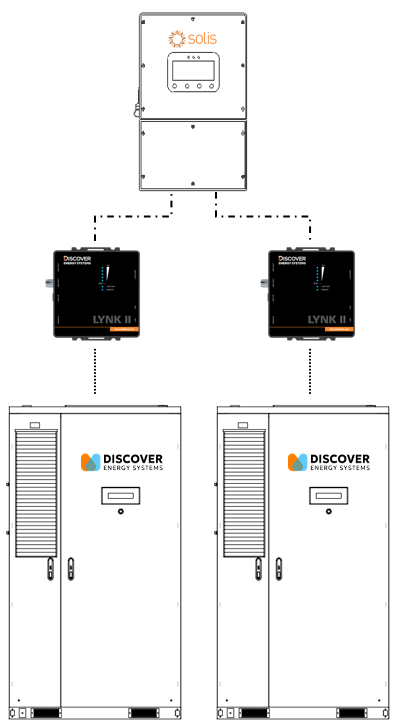
Each AES battery cabinet uses its own LYNK II Gateway for managed (closed-loop) communication with the Solis inverter in a two-to-one configuration. The inverter’s two BMS ports (BMS1 and BMS2) allow it to communicate with each battery independently.
-
Use standard CAT6 or higher Ethernet cables, wired in a straight-through configuration with RJ45 plugs on both ends.
-
Connect one cable from LYNK II #1 CAN port to the Solis inverter’s BMS1 port. Connect another cable to LYNK II #1’s LYNK port to the J3/J4 port on the AES Cabinet’s High Voltage Box. On most AES Cabinets, a CAT6 cable is already connected to the J3 port on the AES Cabinet’s High Voltage Box and is accessible from the LYNK II.
-
Connect a third cable from LYNK II #2 CAN port to the Solis inverter’s BMS2 port. Connect a fourth cable from LYNK II #2’s LYNK port to the J3/J4 port on the AES Cabinet’s High Voltage Box.
This setup enables the inverter to independently manage and monitor both battery cabinets, receiving real-time data for state of charge, voltage, current, temperature, and charge/discharge limits from each LYNK II Gateway. Two independent LYNK II Gateways ensure precise, safe, and optimized performance across both battery units.