
The Thermal Management System (TMS) in the AES Cabinet regulates battery temperature across diverse operating environments through automatic heating, cooling, and standby modes. The system dynamically adjusts based on real-time sensor data from each battery pack to maintain optimal performance, safety, and longevity.
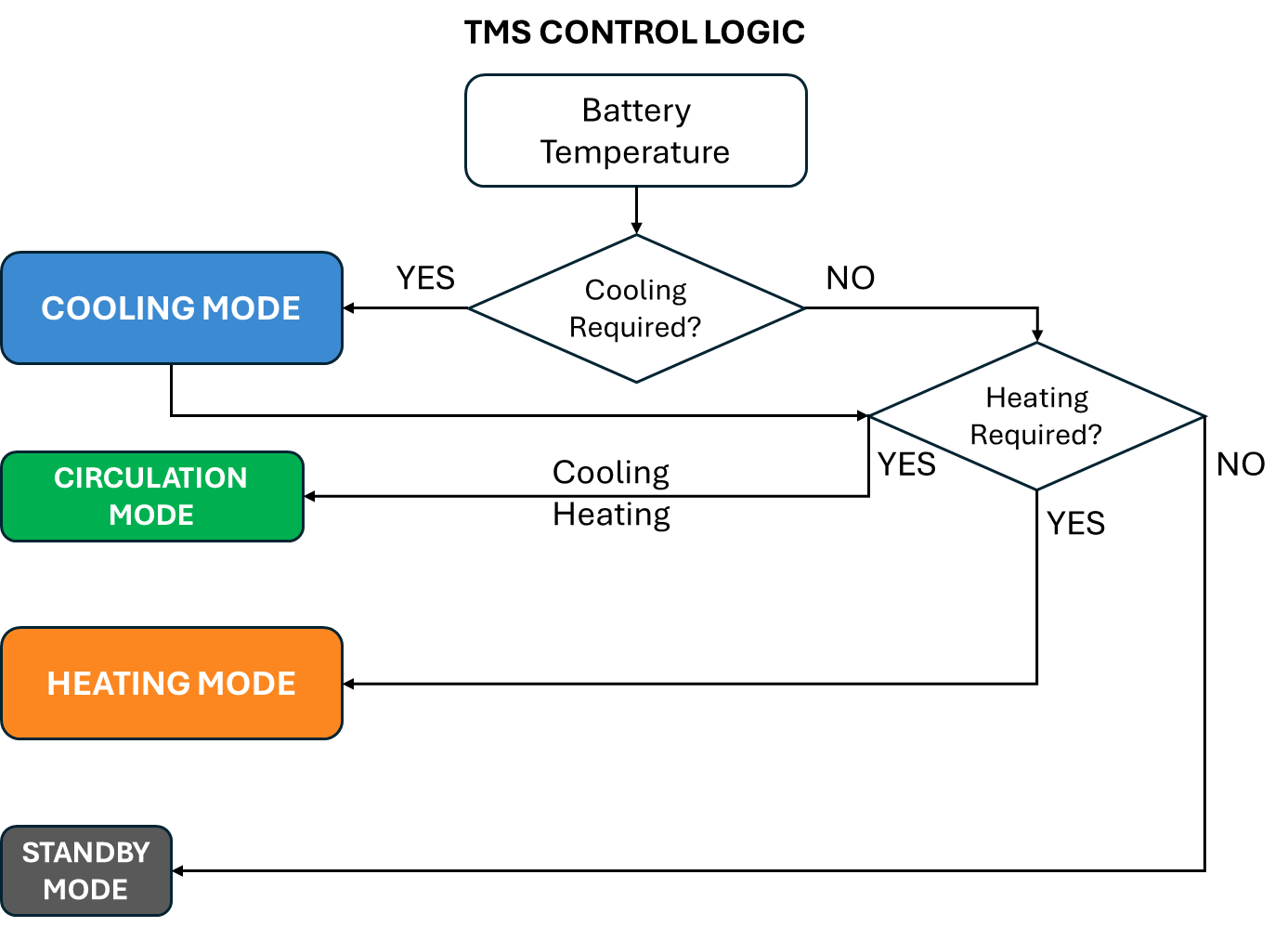
Operation Logic
|
Mode |
Activation Condition |
Deactivation Condition |
Operational Process |
|---|---|---|---|
|
Cooling Mode |
Cooling turns ON if Avg. Temp ≥ 30°C (86°F) OR any single pack Temp ≥ 32°C (89.6°F). (Applies to both charging & discharging.) |
Cooling turns OFF if Avg. Temp ≤ 28°C (82.4°F) AND Highest Pack Temp ≤ 30°C (86°F). (Applies to both charging & discharging.) |
TMS receives command → Coolant pump starts (20 s) → Compressor engages (30 s) → Target Coolant Temp: 20°C ±1°C (68°F ±2°F). Compressor power dynamically adjusts to prevent condensation. |
|
Heating Mode |
Heating turns ON if:
|
Heating turns OFF if Avg. Temp ≥ 25°C (77°F) AND Lowest Pack Temp ≥ 20°C (68°F). |
TMS receives command → PTC heaters activate → Target coolant output temp: 30°C (89.6°F). Heating remains active until all packs reach a safe temperature. Charging resumes after safe warm-up. |
|
Standby Mode |
No active heating or cooling required. |
N/A |
TMS monitors temperature but does not engage any thermal control. |
|
Mode Priority and Conflict Resolution |
If any individual pack triggers heating or cooling, it takes system-wide priority. If both are triggered simultaneously, the system enters self-circulation mode. |
N/A |
In self-circulation mode, glycol circulates to balance temperature without active heating or cooling. |
Operation Details
Cooling Mode
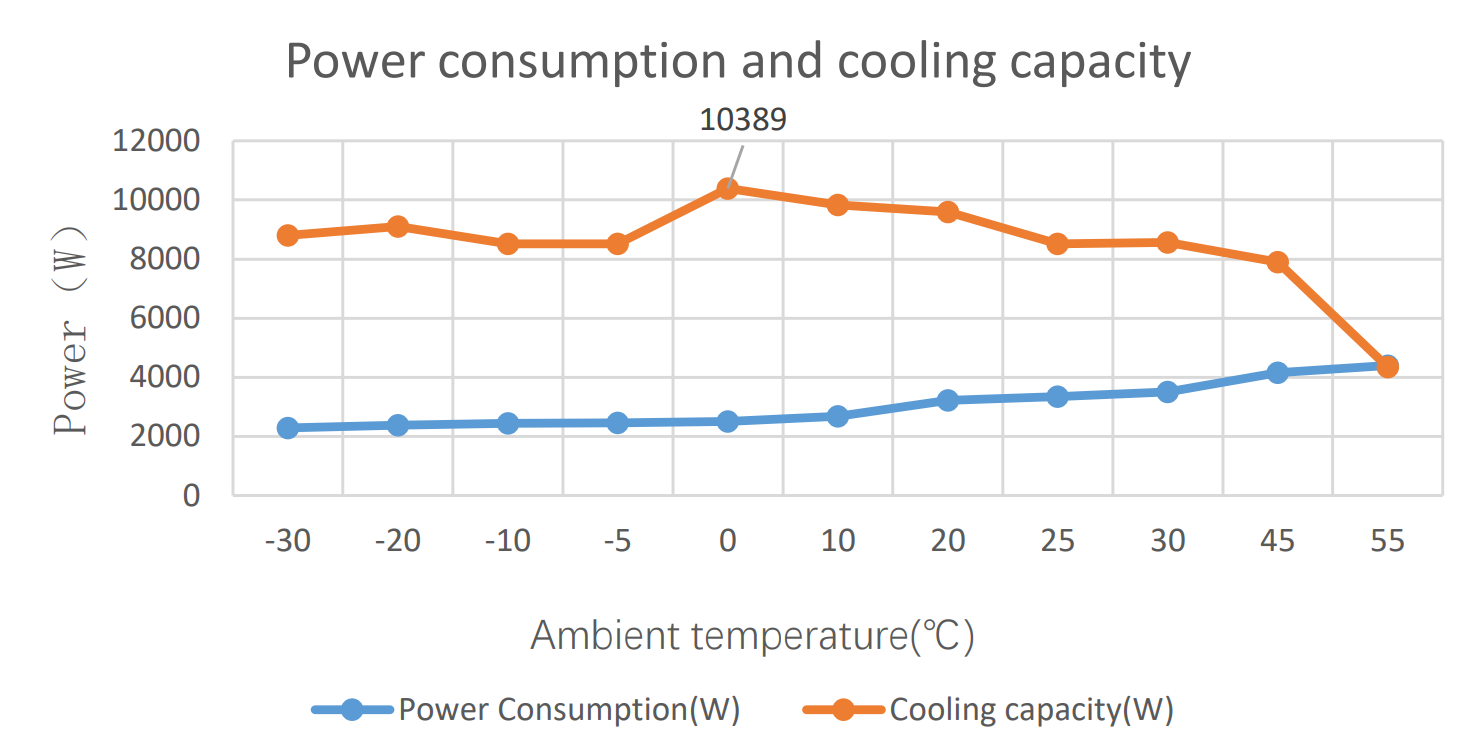
The TMS effectively cools the AES Cabinet by circulating glycol-based coolant through heat exchanger plates attached to each battery pack, extracting heat directly from the cells. The heated coolant is then passed through an evaporator, where a refrigerant loop absorbs the thermal energy and rapidly cools the fluid. Three high-efficiency fans expel this heat from the condenser to the outside environment, while the system dynamically adjusts compressor power to maintain a stable coolant temperature of 20°C ±1°C (68°F ±2°F) for consistent and efficient thermal regulation.
-
Activation
-
Average pack temperature ≥ 30°C (86°F), or
-
Any individual pack ≥ 32°C (89.6°F)
-
-
Deactivation
-
Average pack temperature ≤ 28°C (82.4°F), and
-
All individual packs ≤ 30°C (86°F)
-
-
Sequence
-
Coolant pump starts within 20 seconds
-
Compressor engages after 30 seconds
-
Coolant is regulated to 20°C ±1°C (68°F ±2°F), adjusted dynamically based on load and ambient conditions
-
|
NOTE |
|---|
|
Cooling takes priority over other operations unless heating is also needed, in which case the system shifts to self-circulation mode for passive thermal balancing. |
Heating Mode
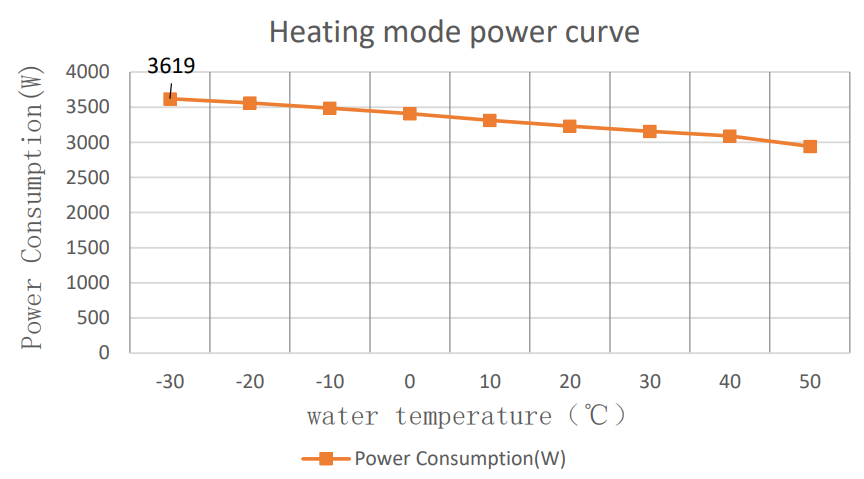
The TMS heats the AES Cabinet system by directing glycol-based coolant through integrated PTC (Positive Temperature Coefficient) heaters, which warm the fluid before it circulates through the battery pack heat exchangers. This process delivers controlled thermal energy directly to the cells, raising their temperature uniformly in cold environments. The system maintains a target coolant output temperature of 30°C (86°F).
-
Activation During Discharge
-
Average pack temperature ≤ –5°C (23°F), or
-
Any individual pack ≤ –10°C (14°F)
-
-
Activation During Charging
-
Average pack temperature ≤ 10°C (50°F), or
-
Any individual pack ≤ 5°C (23°F)
-
-
Deactivation (Both Modes)
-
Average pack temperature ≥ 25°C (77°F), and
-
All individual packs ≥ 20°C (68°F)
-
-
Heating Target
Coolant is maintained at 30°C (86°F) until batteries reach safe operating temperatures. Charging and discharging are limited until this condition is met.
Standby and Conflict Logic
-
Standby Mode
If no cooling or heating conditions are met, TMS enters standby. Monitoring continues, but no active thermal control is applied. -
Self-Circulation Mode
If both cooling and heating thresholds are triggered (such as some packs are cold, while others are hot), the TMS circulates coolant without activating heating or cooling modes. This balances temperatures passively and avoids unnecessary energy use.
Fault Handling
|
Condition |
System Response |
|
BCU-TMS Communication Loss (30s+) |
TMS enters standby, BMS logs Level 1 alarm, alert issued |
|
Cooling or Heating Hardware Failure |
TMS enters self-circulation mode, fault alarm triggered |
|
Temperature Sensor Error |
TMS halts active control, logs fault, and restricts charge/discharge |
|
NOTE |
|---|
|
System parameters and setpoints may be adjusted by authorized service personnel. |