Skip table of contents

THERMAL MANAGEMENT SYSTEM ARCHITECTURE

The Thermal Management System (TMS) regulates the temperature of battery cells in the AES Cabinet.
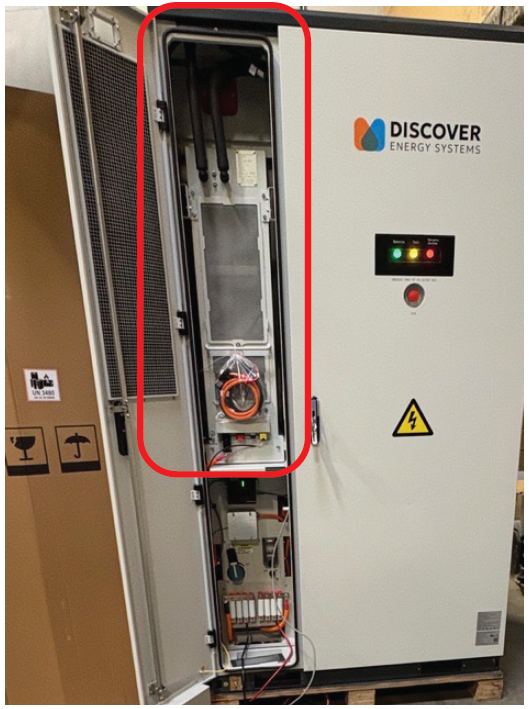
image-20260303-002324.png

Thermal Management System (TMS)

image-20260303-002756.png

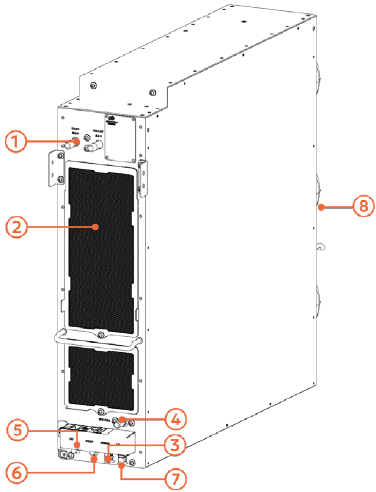
  1. Inlet / Outlet: Connects to the cooling system for liquid coolant circulation through the TMS system.

  2. Air Intake: Facilitates air intake for the cooling mechanism of the TMS.

  3. Debug/Service Port: Used for diagnostics, testing, and software updates.

  4. Charge Pipe: Allows coolant to be refilled into the system.

  5. AC Input: Provides AC power to the TMS.

  6. Pump DC Power Input: Supplies power to the liquid coolant pump during maintenance or service operations.

  7. Proprietary Communication Port: Connects the TMS to other internal systems.

  8. Air Exit: Supports ventilation and heat dissipation by facilitating air exhaust using three fans.

TMS System Design

  • Liquid Cooling Loop: Closed-loop glycol-water mix (50:50) with variable-speed pump.

  • Refrigeration Circuit: R-513A refrigerant compressor that provides ≥8 kW cooling capacity at 45°C (113°F) ambient temperatures.

  • Heating Elements: PTC resistive heaters (≥2.5 kW) for cold-weather operation.

  • Integrated Controls: Each cabinet uses a Battery Control Unit (BCU) and Battery Monitoring Units (BMUs) for real-time regulation.

  • Sensors: Multiple NTC thermistors at pack and cell level.

JavaScript errors detected

Please note, these errors can depend on your browser setup.

If this problem persists, please contact our support.