
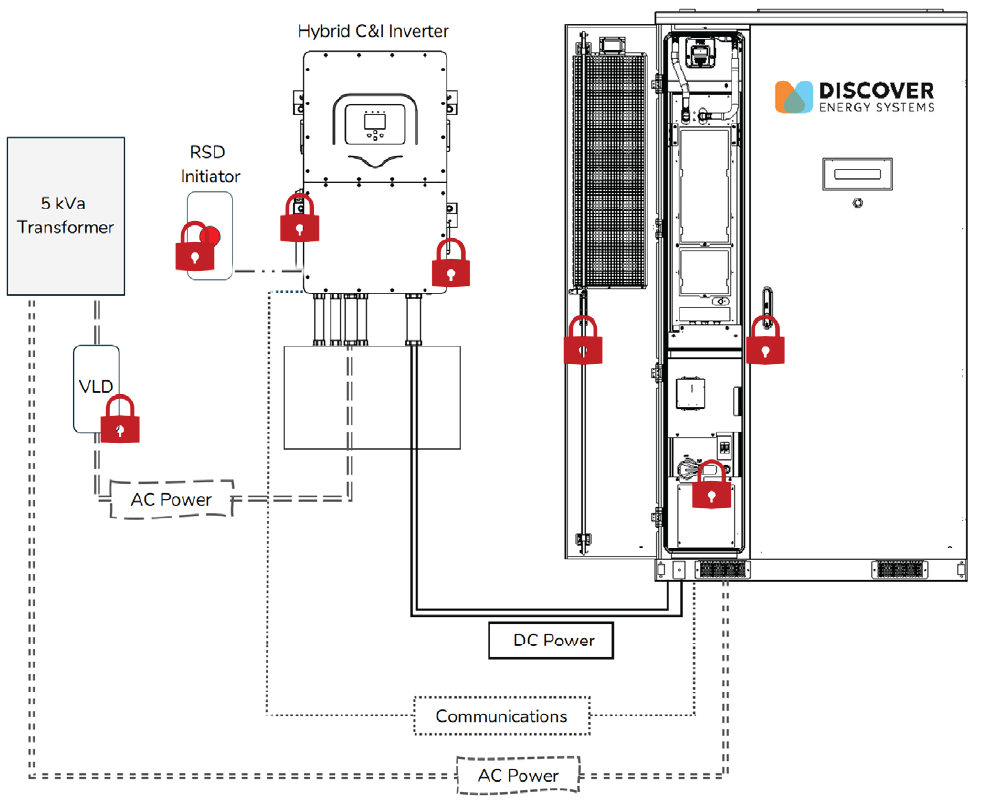
Designated Lockout Points and the Components Disconnected
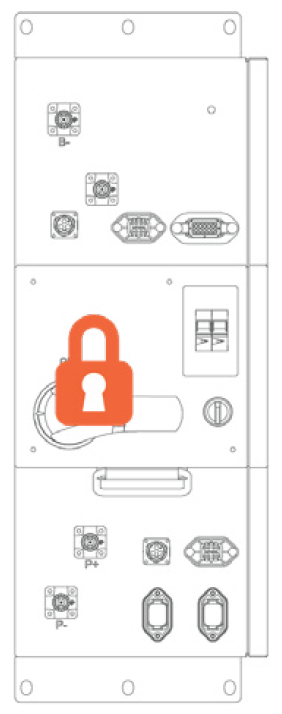
AES 210HV Lock Out and Tag Out
|
|
|---|
|
ELECTRIC SHOCK HAZARD
Failure to follow these instructions may result in death or serious injury. |
-
Prepare for Shutdown
-
Notify all affected personnel of the intended shutdown of the battery cabinet.
-
Identify all energy sources connected to the battery cabinet, such as electrical, DC, and AC.
-
-
Shutdown Battery Cabinet
-
Turn off the battery cabinet using the standard shutdown procedure. See “Normal Shutdown Procedure” in the SYSTEM START-UP AND COMMISSIONING topic.
-
-
Isolate Energy Sources
-
To fully isolate the battery cabinet from all sources, disconnect or turn off all energy sources, such as AC disconnects (VLD, Visible Lockable Disconnect), AC breakers, and DC disconnect switches.
-
Remove the battery pack Manual Service Disconnect (MSD) from each battery pack to completely isolate the batteries.
-
-
Apply Lockout Devices
-
Attach lockout devices to all energy isolation points of the system. Shut and lock all cabinet doors where necessary.
-
Ensure each lock is uniquely keyed and accessible only by the person performing the lockout.
-
-
Apply Tags
-
Attach a tag at each isolation point indicating the reason for the lockout, the responsible person, and the date/time.
-
Ensure tags are durable and highly visible.
-
-
Verify Isolation
-
Verify with a voltmeter or other voltage sensing device that the terminals are no longer electrically live (AC, DC, or other).
-
-
Perform Maintenance/Service
-
Conduct the necessary maintenance or service while the battery cabinet remains locked out.
-
-
Restore Power
-
After completing all work, remove all tools and ensure the area around the battery cabinet is clear.
-
Have the person who installed the locks and tags remove them in reverse order.
-
Restore power to the battery cabinet and notify personnel that it is back in operation.
-