The AES Cabinet is a high-voltage lithium iron phosphate (LiFePO₄) battery energy storage system designed for grid-tied, off-grid, and hybrid applications. It is built around a fully integrated cabinet containing battery modules, thermal management, safety systems, and communications.
Four to eight liquid-cooled battery packs are at the system’s core, with each battery pack configured as 1P52S (52 cells in series). Each pack delivers a nominal voltage of 166.4 Vdc. The battery packs are connected in series to provide a system voltage from 665.6 to 1331.2 Vdc (nominal), with a usable energy capacity from 209 to 418 kWh.
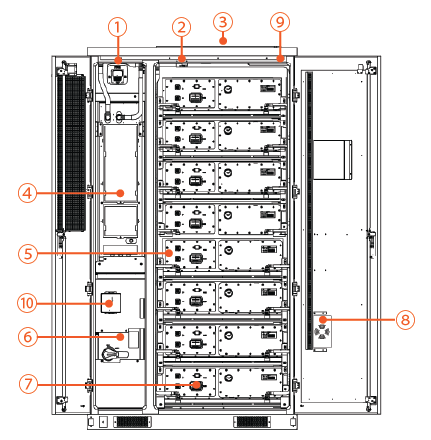
AES Cabinet, Front Doors Open
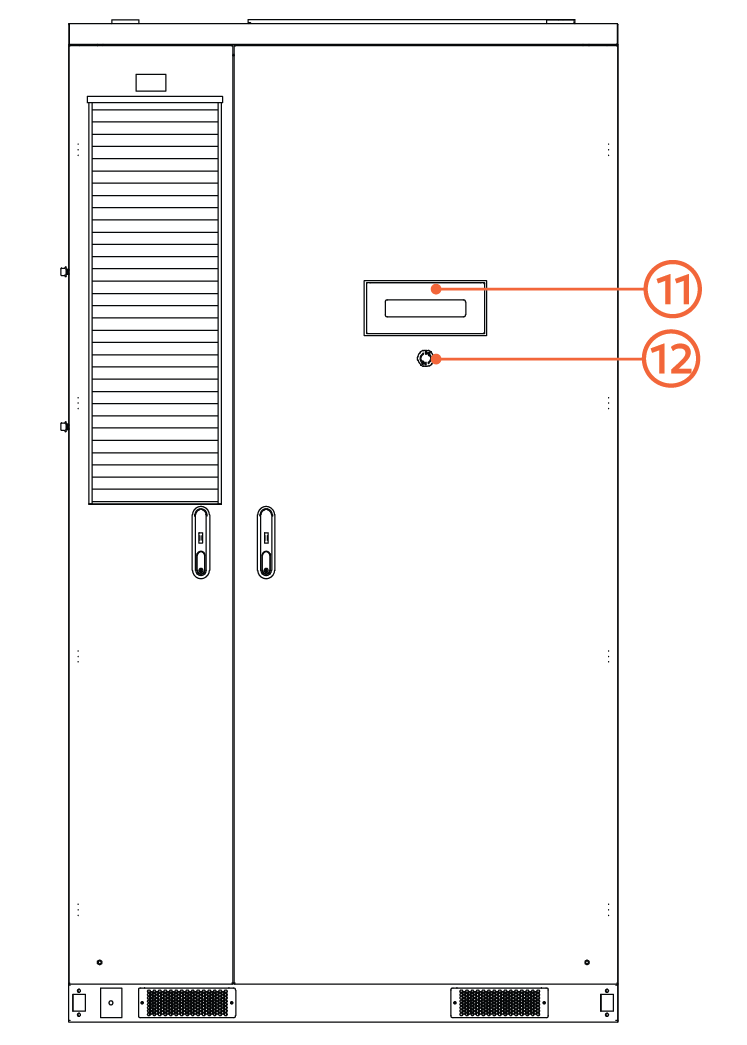
AES Cabinet, Doors Closed
|
No. |
Name |
Description |
|---|---|---|
|
1 |
Audible and Visual Fire Alarms |
In the event of a fire hazard, the battery cabinet activates the thermal suppression device and sounds an alarm. |
|
2 |
Heat and Smoke Detector |
Smoke detection triggers an alarm, while heat detection activates an alarm and the thermal suppression system. |
|
3 |
Passive Deflagration Vent |
Explosion control vents relieve pressure during thermal events by venting gases, which helps minimize the risk of explosion. |
|
4 |
Thermal Management System (TMS) |
The TMS manages heating and cooling for the battery cabinet. |
|
5 |
Battery Packs |
Energy storage units with integrated cell monitoring via the Battery Management Unit (BMU). Each pack features an aerosol fire suppression system and aerogel-based cell separation, ensuring advanced thermal runaway mitigation. |
|
6 |
High Voltage Box (HV Box) |
The HV Box manages power flow, protects the system, provides redundant control via UPS, and monitors the system through the Battery Control Unit (BCU). |
|
7 |
Manual Service Disconnect (MSD) |
Each battery pack is equipped with a Manual Service Disconnect (MSD). |
|
8 |
Dehumidifier |
The humidifier maintains humidity inside the sealed battery cabinet at an acceptable level. |
|
9 |
Cabinet Aerosol Fire Suppression Device |
If a high heat event is detected, the aerosol fire suppression system is automatically activated to quickly release an aerosol fire suppression agent. |
|
10 |
LYNK II Gateway |
The LYNK II Gateway facilitates communication between the battery cabinet BCU and external devices, such as inverters or cloud-based systems. |
|
11 |
LED Indicators |
The LEDs indicate the system operation status:
|
|
12 |
E-Stop |
Emergency stop switch for manual shutdown of the battery cabinet. |