When using the Schneider Electric inverter, the system operates optimally when the battery SOC is used as the driving value rather than voltage, especially when the Grid Support function is enabled.
|
NOTE |
|---|
|
Battery Settings
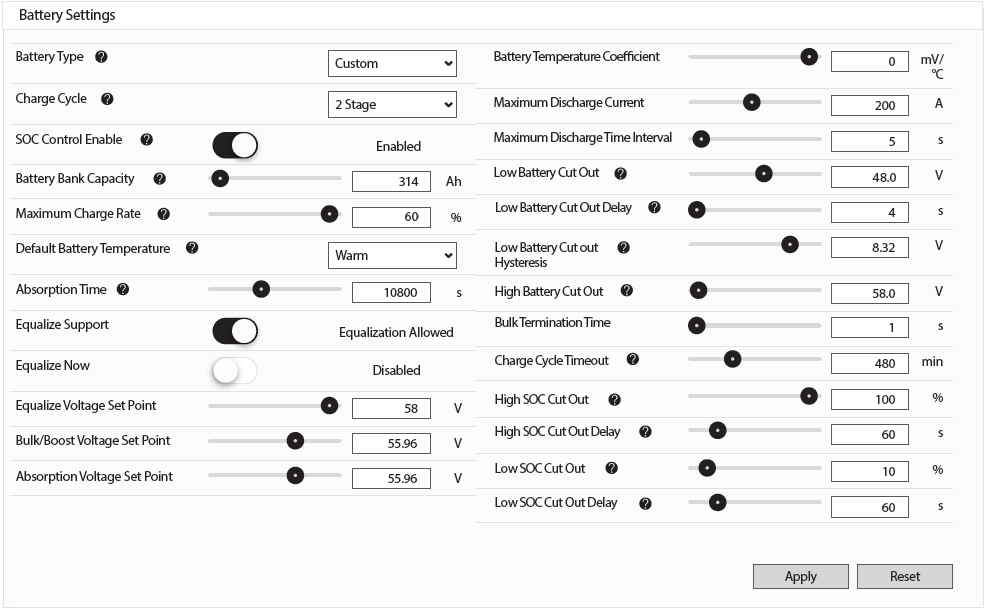
InsightLocal > Devices > Inverter/Chargers > Configuration (Advanced) > Battery Settings
|
InsightLocal > Battery Settings |
Description |
|---|---|
|
Battery Type (Flooded, GEL, AGM, Custom, Li-ion) |
In a closed-loop system, the BMS programs this property. |
|
Charge Cycle (3 Stage, 2 Stage, External BMS) |
Set to 2 Stage (Bulk and Absorption). |
|
SOC Control Enable (Enabled/Disabled) |
When a Discover battery is selected in the BMS Setup dialog box, this property defaults to Enabled. |
|
Battery Capacity (Ah) |
In a closed-loop system, the BMS programs this property. |
|
Maximum Charge Rate (%) |
Default: 100%. If required, use this setting to de-rate the charger output of each device in the system. This is not a system-wide setting. The maximum charge current delivered by the entire system should not exceed the maximum charge current rating of the entire battery system. |
|
Default Battery Temperature (Hot, Warm, Cold) |
In a closed-loop system, the BMS programs this property. |
|
Absorption Time (Seconds) |
|
|
Equalized Support (Yes/No) |
|
|
Equalize Now (Yes/No) |
|
|
Equalization Voltage Set Point (V) |
|
|
Bulk/Boost Voltage Set Point (V) |
|
|
Absorption Voltage Set Point (V) |
|
|
Float Voltage Set Point (V) |
|
|
Battery Temperature Coefficient (mV/°C) |
Recommended: 0 mV/° C. In a closed-loop system, the BMS communicates the battery voltage based on the internal battery temperature. |
|
Maximum Discharge Current (A) |
In a closed-loop system, the BMS programs this property. |
|
Maximum Discharge Time Interval (Seconds) |
|
|
Low Batt Cut Out (V) |
|
|
Low Batt Cut Out Delay (Seconds) |
Recommended: 10 seconds or less. Setting the Low Batt Cut Out Delay avoids unnecessary engagement of the BMS safety features. |
|
Low Battery Cut-Out Hyst |
In a closed-loop system, the BMS programs this property. |
|
High Batt Cut Out (V) |
|
|
Bulk Termination Time (Seconds) |
Recommended: 1 second. See the inverter documentation for additional user-specified Grid Support settings. |
|
Charge Cycle Timeout (Minutes) |
Recommended: 480 minutes. |
|
High SOC Cut Out (%) |
Recommended: 99%. Setting this value instead of 100% avoids unnecessary engagement of the BMS. |
|
High SOC Cut Out Delay (Seconds) |
Recommended: 60 seconds. This property avoids unnecessary engagement of the BMS safety features. |
|
Low SOC Cut Out (%) |
Recommended: 25%. Adjust to match your particular use case. To fully discharge the battery to 100% Depth of Discharge, it must be recharged immediately to avoid cell damage. An over-discharged battery may not accept a charge and may become unrecoverable. |
|
Low SOC Cut Out Delay (Seconds) |
Recommended: 60 seconds. This property avoids unnecessary engagement of the BMS safety features. |
Charger Settings
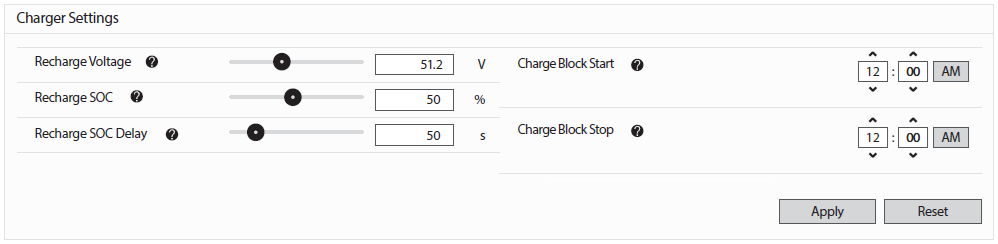
InsightLocal > Devices > Inverter/Chargers > Configuration (Advanced) > Charger Settings
|
InsightLocal > Charger Settings |
|
|---|---|
|
Recharge Voltage (V) |
When SOC Control is enabled, this setting is ignored. When Comms Lost (Open Loop), the set battery voltage specifies when recharging begins. Recommended: 51.2 V. |
|
Recharge SOC (%) |
Specifies the amount of energy to keep in reserve for backup. Setting a lower SOC enables a higher level of self-consumption. |
|
Recharge SOC Delay (seconds) |
Specifies the amount of delay before recharging. |
|
Charge Block Start
|
Charge Block specifies when AC charging from the grid is blocked. Specify the time range when AC charging is blocked. |