
The Power Conversion device will require setting up a charging profile even if you use closed-loop charging. Using the controller of the Power Conversion device, set up a charging configuration with a Lithium charge profile that matches the charge and discharge settings. Refer to Electrical Specifications for charging parameters.
Refer to the appropriate Application Note from www.discoverenergysys.com for setting up closed-loop parameters and integrating inverter-chargers and battery chargers.
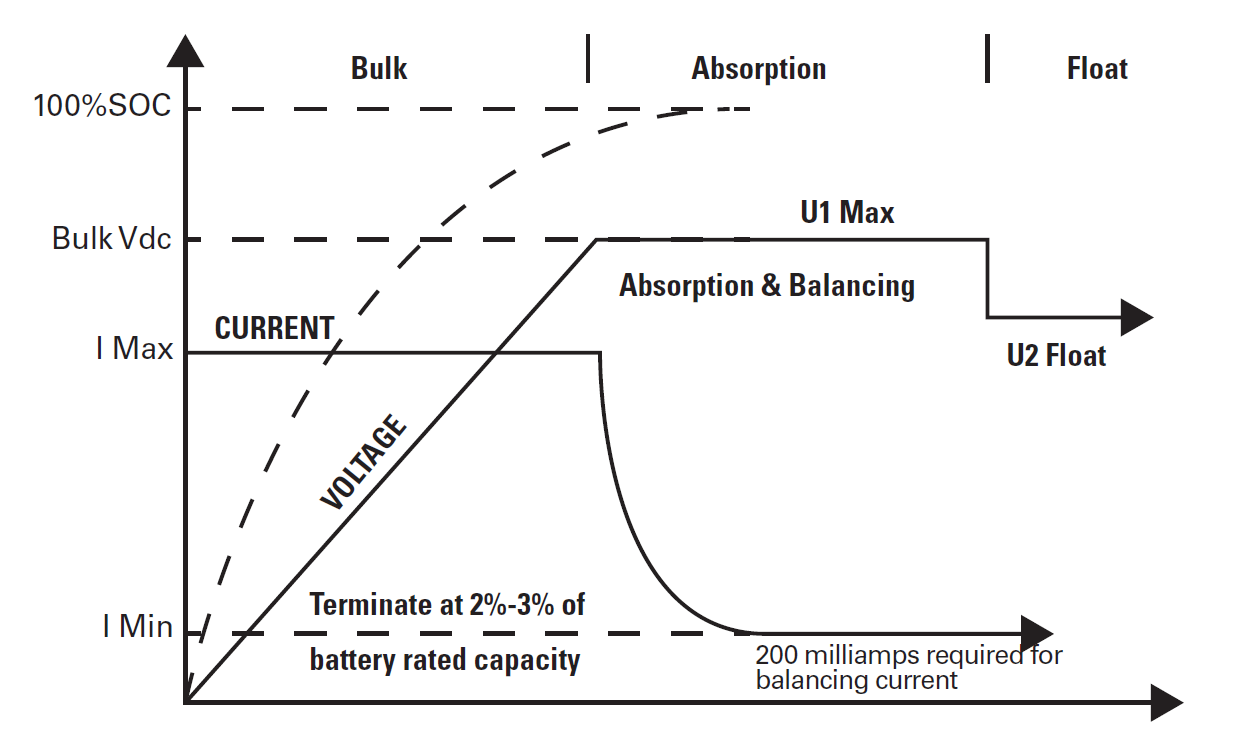
Charge Graph
|
NOTICE |
|---|
|
BATTERY DAMAGE
Failure to follow these instructions may result in equipment damage. |
|
NOTE |
|---|
|
Charging at 50% of nominal current or lower will extend the battery cycle life. |
Bulk Charge
Bulk phase. The Bulk Charge is the first phase of the charging process, called the constant current phase. This phase is when the charger’s maximum current is directed to the battery until reaching the desired voltage. The Bulk phase will recharge the battery to approximately 90-95% SOC.
A single-stage charge may be appropriate if the charging source is a generator or other charge source that is inefficient at low output current. A single-stage charge will only complete the Bulk phase portion of the charge curve. This method should return the battery to 90-95% SOC.
Refer to Electrical Specifications for charging parameters.
Absorption Charge
Absorption phase. The second phase of the charging process is Absorption Charge, also called the constant voltage phase. In this phase, the charger reduces current accordingly to maintain the desired voltage.
Refer to Electrical Specifications for charging parameters.
Equalization Charge
|
|
|---|
|
FIRE AND BURN HAZARD Do not perform an equalization charge on the HELIOS ESS battery. Failure to follow these instructions may result in injury. |
Do not equalize charge the HELIOS ESS battery. Equalization charging is intended only for lead-acid batteries. An equalization charge is a purposeful overcharge that targets a voltage above the standard charge voltage to remove sulphate crystals that form on lead-acid plates over time.
Float Charge
Float phase. Float charge, the third phase of charging, is optional. During this stage, the battery is maintained at 100% SOC for extended periods, thereby counteracting self-discharge and parasitic loads.
-
Not necessary. Float charging is not required.
If needed, refer to Electrical Specifications for float parameters.