
|
|
|---|
|
ELECTRIC SHOCK AND FIRE HAZARD
Failure to follow these instructions may result in injury. |
|
NOTICE |
|---|
|
UNBALANCED BATTERY CELLS Paralleling more than three batteries using the Parallel Wiring Kit may lead to unbalanced battery cells. Failure to follow these instructions may result in equipment damage. |
|
NOTICE |
|---|
|
EQUIPMENT DAMAGE When paralleling multiple batteries, the maximum current is limited by the internal busbars in the HELIOS ESS battery. For the maximum current values of batteries in parallel, refer to the table in the Minimum Specifications for Battery Systems topic. Failure to follow these instructions may result in equipment damage. |
Batteries used in a parallel system must meet the following requirements:
-
Same model. Batteries must be the same model.
-
Equal voltage. The battery has a Pre-Charge System that allows you to connect batteries at different SOC. The best practice is to confirm batteries are within 50 mV (0.05 V) of each other before installing them in parallel.
|
NOTE |
|---|
|
To connect HELIOS ESS batteries in parallel, use busbars, the HELIOS ESS Parallel Wire Kit (950-0068), or create your own appropriately-sized cables with the HELIOS ESS Terminal Connector Set (950-0072). |
The following instructions identify how to connect batteries and inverters in parallel using the HELIOS ESS Parallel Wire Kit (950-0068). One kit is required to parallel two batteries. Two kits are required to parallel three batteries.
Install equipment following the standards set by the local authority having jurisdiction.
-
Prepare the load and battery for wiring.
-
If the load is wired to a power source, open the disconnect and set the load OFF.
-
Use a DMM or other voltage measuring device to confirm the circuit is de-energized.
-
If the circuit in which the battery is installed has a disconnect, open the disconnect to isolate the battery.
-
Set both the battery BMS and the breaker to the OFF position.
-
Use a DMM or other voltage measuring device to confirm the circuit is de-energized.
-
-
Wire the DC load.
The Battery to Inverter Power Cables 2/0 AWG (950-0070) are available to wire the batteries to the DC load. Confirm the cable is compatible with your inverter and inverter settings.
|
NOTE |
|---|
|
a. Ensure the cable connections are clean and in working order.
b. Connect the positive battery cable to a positive battery terminal on the DC load.
c. Connect the negative battery cable to a negative terminal on the DC load. Do not connect them to the batteries yet.
-
Connect the positive (+) battery cable in the HELIOS ESS Parallel Wire Kit (950-0068) to a receiving pin of the positive battery terminals on a battery at one end of the battery bank. Push the ends of cables against the receiving pins to secure the connection.
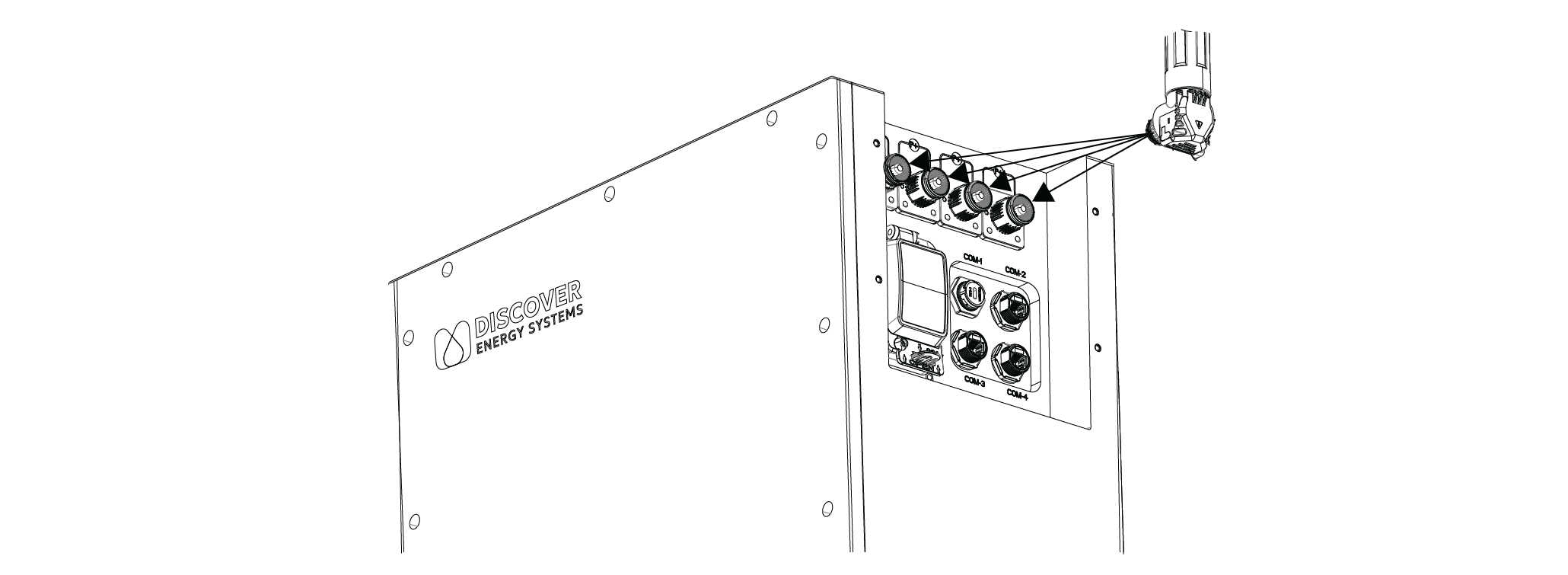
Connect Cables to Battery Terminals
-
Connect the negative (-) battery cable to a receiving pin of the negative battery terminals on the battery at the other end of the battery bank. Push the ends of cables against the receiving pins to secure the connection.
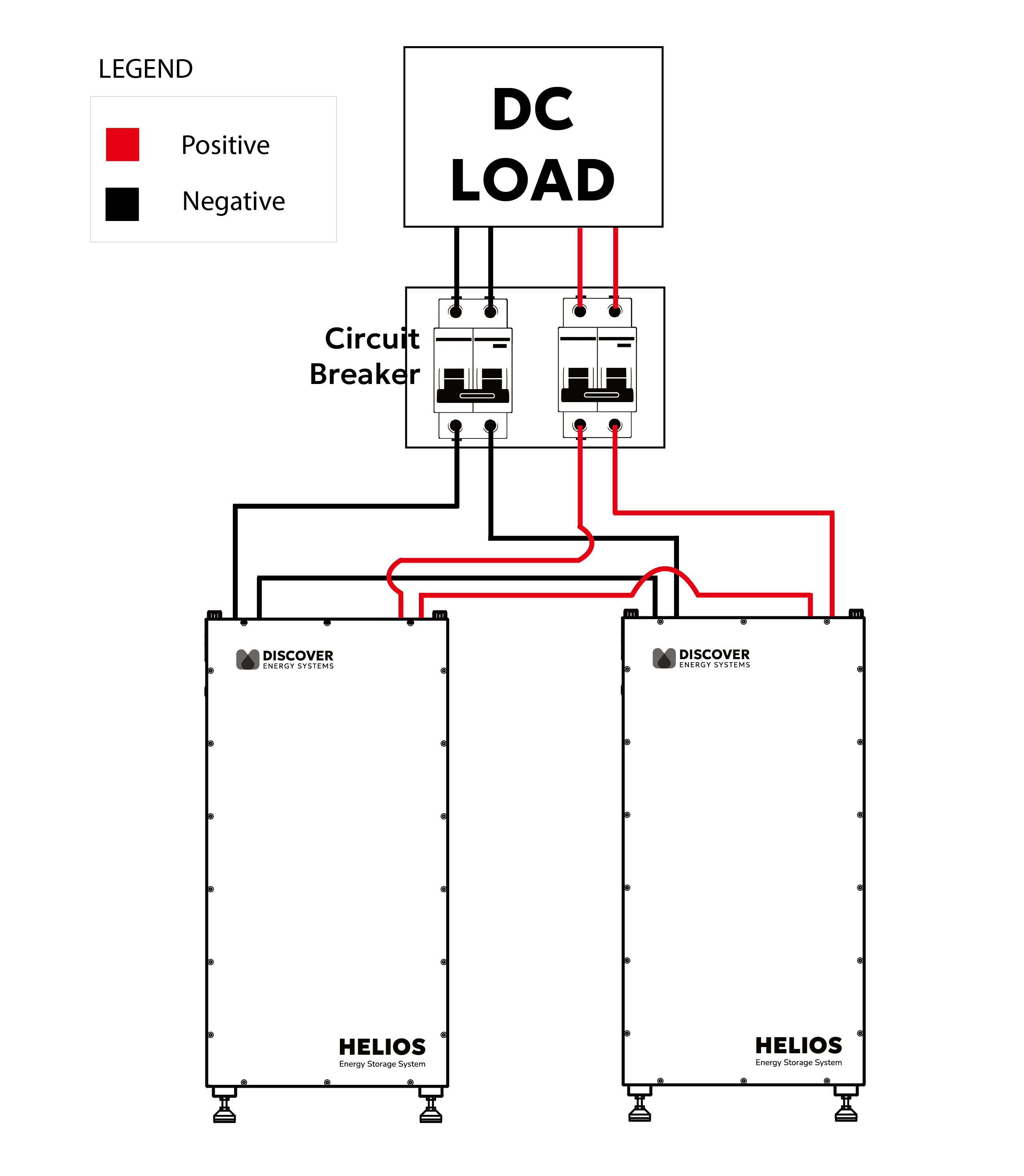
Two Batteries in Parallel (One Parallel Wire Kit 950-0068)
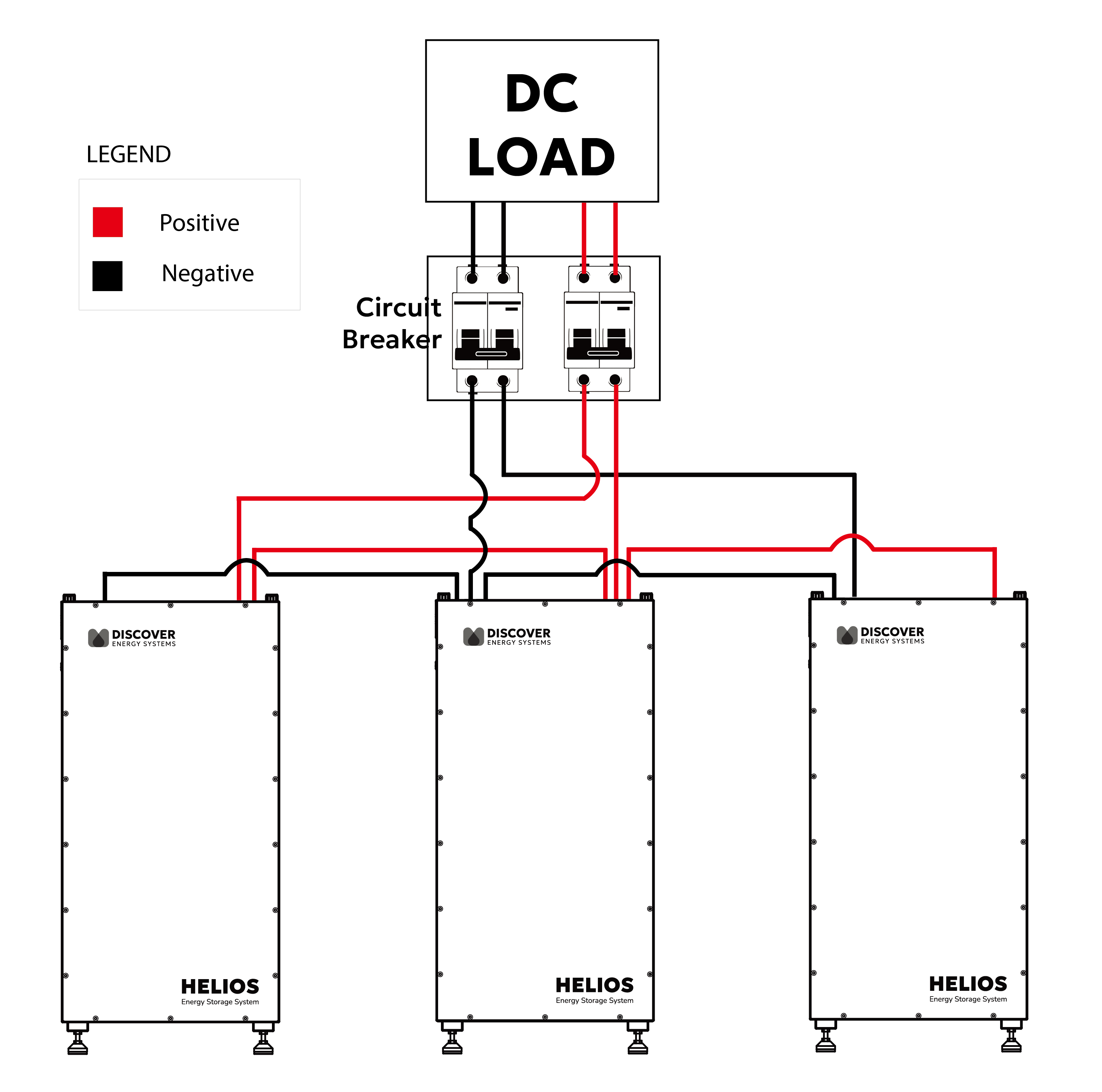
Three Batteries in Parallel (Two Parallel Wire Kits 950-0068)
-
Connect the positive (+) and negative (-) battery cables in the HELIOS ESS Parallel Wire Kit (950-0068) to the receiving pins of the positive and negative battery terminals on batteries, as shown in the diagrams. Push the ends of cables against the receiving pins to secure the connection. Refer to “Terminal Connections and Hardware” in the Wiring topic.
-
Connect the positive battery cables from the DC load to batteries in the battery bank, and connect the negative batteries cables from the DC load to batteries in the battery bank as shown in the images above. Push the ends of cables against the receiving pins to secure the connection.
-
Connect the CAN communication cables.
-
Set all battery BMS to ON (ON/OFF key).
-
Energize the system by setting all battery breakers to ON (close).
-
Close the circuit disconnect if it is open.
|
NOTICE |
|---|
|
TERMINAL BURNOUT Failure to securely lock the ends of battery cables to the receiving pins on the battery will increase resistance and lower voltage, leading to burnout of the terminals and voiding of the warranty. Failure to follow these instructions may result in equipment damage. |
|
NOTE |
|---|
|